Porter’s Five Forces
Assessing the competitive environment using Porter’s Five Forces framework: key principles, analysis stages, and practical applications.
Content
1. Introduction
Launching a new product, entering a new market, or scaling a business without understanding the competitive landscape is always a risk. You may invest significant time and resources only to discover that the market is overcrowded, suppliers hold too much bargaining power, or customers can easily switch to competitors.
To avoid these pitfalls, businesses often use Porter’s Five Forces framework. It is one of the most widely recognized strategic analysis tools, helping organizations evaluate not only their competitors but also the broader forces that shape the market in which they operate.
The framework was developed by American economist Michael Porter in 1979. Its core idea is straightforward: a company's profitability depends not only on the quality of its products or the effectiveness of its team, but also on several external forces that determine the level of competition within an industry.
By understanding these forces, businesses can identify potential threats, uncover weaknesses in their strategy, and make more informed strategic decisions before problems arise.
Today, Porter’s Five Forces is used not only by large corporations. It is equally valuable for small business owners, marketers, sales managers, consultants, and anyone involved in business strategy and growth.
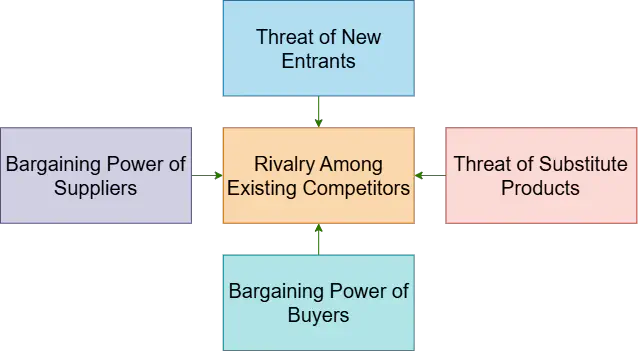
2. What Forces Does Porter’s Model Analyze?
2.1 Rivalry Among Existing Competitors
When dozens of companies offer similar products or services, competition is often driven by pricing, advertising, promotions, and discounts. In these conditions, maintaining strong profit margins becomes much more challenging.
For example, the food delivery and online education industries are highly competitive. New businesses enter the market regularly, and customers can switch to another provider with just a few clicks.
When competitive rivalry is intense, companies need to differentiate themselves by improving customer service, strengthening their brand, offering additional value, or developing unique products and services.
2.2. Threat of New Entrants
Some markets are relatively easy to enter, while others are protected by significant barriers to entry. For example, launching an online clothing store can be done fairly quickly. Building a mobile network operator or starting an airline, however, is an entirely different challenge. These industries require substantial capital investment, regulatory approvals, complex infrastructure, and compliance with numerous legal and industry requirements.
2.3. Bargaining Power of Buyers
Companies are not always the ones setting the terms of a transaction. In many industries, buyers hold significant bargaining power. When customers can easily switch to a competitor, they become more demanding about pricing, service quality, and the overall value they receive.
The banking industry is a good example. Today, customers can switch banks or open an account with another provider in just a few minutes. As a result, financial institutions compete aggressively for customers by offering cashback, rewards programs, lower fees, and more attractive pricing.
2.4. Bargaining Power of Suppliers
Many businesses depend on their suppliers far more than they may realize. When raw materials, components, or specialized equipment are available from only a limited number of suppliers, those suppliers gain significant bargaining power. They can increase prices, alter delivery schedules, or impose less favorable contract terms.
This issue becomes especially apparent during economic crises or supply chain disruptions. A single breakdown at one point in the supply chain can have a ripple effect, impacting the operations of dozens of companies.
To reduce this risk, businesses typically avoid relying on a single supplier. Building relationships with multiple reliable suppliers and securing alternative sources of supply helps minimize the risk of production delays and unexpected increases in operating costs.
2.5. Threat of Substitute Products
Sometimes customers solve the same problem in a completely different way. For example, movie theaters compete not only with one another but also with streaming services. Taxi companies compete with car-sharing services, bicycles, and public transportation. Printed books compete with e-books and audiobooks.
As the number of substitutes increases, businesses must continually demonstrate why customers should choose their product over alternative solutions.
3. How to Conduct a Porter’s Five Forces Analysis?
A Porter’s Five Forces analysis begins by defining the market you want to evaluate. It is important to avoid choosing a market that is too broad. For example, analyzing the "furniture market" provides only a limited understanding of the competitive landscape. Instead, focus on a specific segment, such as office furniture manufacturing, online kitchen furniture retailers, or the designer furniture market within a particular region. The more precisely the market is defined, the more meaningful and reliable the analysis will be.
The next step is to gather information on each of the five forces. This typically involves using industry reports, market research, company publications, statistical data, expert analyses, and your own observations. It is important to evaluate not only the current state of the market but also how it may evolve over the coming years. For example, entering an industry may be difficult today, but technological advances or regulatory changes could significantly lower barriers to entry in the future.
When assessing competitive rivalry, consider factors such as the number of competitors, their market shares, the industry's growth rate, pricing levels, and the degree of product differentiation. When most companies offer similar products or services, competition tends to intensify, forcing businesses to compete through discounts, marketing campaigns, and value-added services.
It is equally important to evaluate the bargaining power of buyers and suppliers. If customers can easily switch to competitors, they gain greater leverage to demand lower prices, higher service quality, or better terms. A similar situation exists with suppliers. When only a small number of companies provide essential raw materials or components, businesses become increasingly dependent on suppliers' pricing, delivery schedules, and contractual conditions.
Substitute products also deserve careful attention. In many cases, the greatest competitive threat comes not from direct rivals but from alternative ways of solving the same customer need. For this reason, businesses should look beyond traditional competitors and consider any product or service that could divert customer demand.
Once all five forces have been evaluated, it becomes easier to determine how attractive the industry is for doing business. If several forces exert strong pressure simultaneously, maintaining high profitability and defending market position becomes more challenging. Conversely, when the overall competitive pressure is relatively low, businesses have greater opportunities for sustainable growth.
The true value of Porter’s Five Forces, however, lies not in the assessment itself but in the strategic insights it provides. The framework helps organizations identify the most significant risks, determine where they should strengthen their position, and understand which competitive advantages they need to develop in order to succeed over the long term.
4. When Should You Use Porter’s Five Forces Model?
This framework is particularly valuable when strategic decisions need to be based on analysis rather than intuition. It provides a broader view of the competitive landscape and helps identify the external factors that may influence a company's future performance. A Porter’s Five Forces analysis is especially useful if you:
- plan to launch a new business or enter an unfamiliar market
- are preparing to introduce a new product or service
- want to evaluate the attractiveness of an industry before making an investment
- are trying to understand the reasons behind declining profits or customer losses
- are developing a long-term business strategy
5. Advantages and Disadvantages
The main advantage of Porter’s Five Forces framework is that it provides a comprehensive view of the competitive environment. Rather than focusing solely on competitors, it encourages businesses to evaluate all the external factors that can affect profitability, including buyer behavior, supplier bargaining power, the threat of new entrants, and the availability of substitute products. This broader perspective helps organizations identify potential risks early and make strategic decisions based on objective market conditions rather than intuition.
However, the framework is not without limitations. It offers a snapshot of an industry at a particular point in time and may not fully capture the pace of rapidly evolving markets. In sectors such as information technology and digital services, emerging technologies, shifting consumer preferences, and innovative business models can reshape the competitive landscape in a relatively short period. In addition, the model pays little attention to a company's internal strengths, such as the expertise of its team, financial resources, service quality, or brand reputation. For this reason, Porter’s Five Forces is often used alongside other strategic analysis tools to provide a more complete understanding of a company's competitive position and long-term growth potential.
6. Conclusion
Porter’s Five Forces has remained a relevant strategic framework for decades because it encourages businesses to look beyond direct competition. It demonstrates that profitability is influenced not only by rival companies offering similar products or services, but also by buyers, suppliers, potential new entrants, and substitute solutions that address the same customer needs.
By conducting this analysis on a regular basis, businesses can gain a deeper understanding of their competitive environment, make better-informed strategic decisions, and prepare for market changes before they occur rather than simply reacting after the fact.

Ian L. Dolganov
Junior Python Developer
My academic interests focus on Python development, software engineering, backend development, and modern approaches to designing and developing reliable software systems.